
Application Schedule and Product Selection
Pick your turf grass for a suggested year of feeding — the products, the timing and the rate for each window on the Texas Gulf Coast. Rates are starting points: read the bag and adjust to your soil test.
Bermuda program
| Stage | Timing | Product | Rate | Notes |
|---|---|---|---|---|
| Pre-emergent | Mid February | Barricade Pre-Emergent Herbicide | Per label | Barrier first, feed second. Water it in to activate. |
| Green-up | March 15 | Super Turf Fertilizer 19-4-10 | Per label | Bermuda comes out of dormancy early — this is the pass that starts the season. |
| Feed | April | Imperial Lawn Fertilizer 15-5-10 | 5 lb per 1,000 sq ft | Bermuda takes more nitrogen than any other Gulf Coast lawn. Split it across the season. |
| Split nitrogen | June – August | Super Turf Fertilizer 19-4-10 | Per label | Two lighter applications beat one heavy one in sandy Coastal Prairie ground. |
| Disease watch | July – September | Eagle 0.39G Turf Fungicide | Per label | If take-all patch or gray leaf spot shows up, treat it and water the granule in. |
| Winterizer | October 15 | Fall Special 8-12-16 | Per label | Roots, not top growth, are the point of the fall pass. |
01
Test before you spread
A soil test tells you whether you actually need phosphorus this year. Nitrogen leaches; phosphorus and potassium build up and carry over.
02
Water it in
Every granular product on this page wants a good soaking after it goes down — it moves the granule off the leaf and into the root zone.
03
Don't over-feed centipede
Centipede is the exception in the Gulf Coast lawn. Feed it roughly half what you would a Bermuda lawn, and go lighter again in sandy ground.
These recommendations are general guidance for Gulf Coast conditions and are not a substitute for a soil test or the label on the product. Always follow the product label and local regulations.
Ask us about your lawnNitro-Phos program
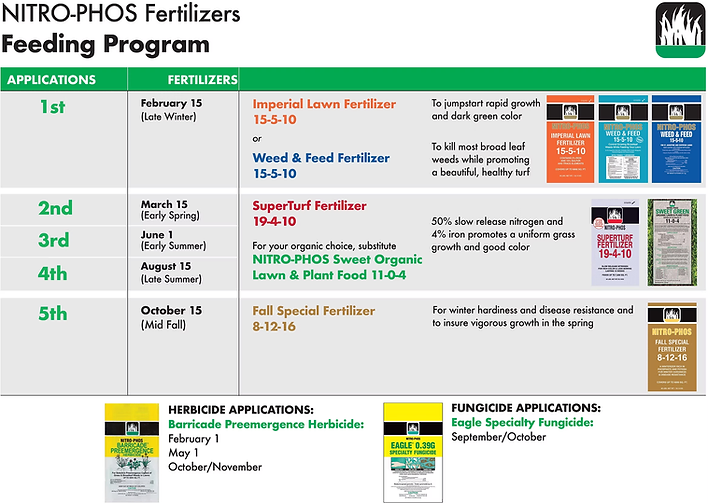
The feeding program year
Five applications from late winter to mid fall — the program as Nitro-Phos publishes it. Dates are the chart's targets for the Texas Gulf Coast; shift them to the weather in front of you.
1st application
February 15
Late Winter
Imperial Lawn Fertilizer 15-5-10orWeed & Feed Fertilizer 15-5-10To jumpstart rapid growth and dark green color — or, with Weed & Feed, to kill most broadleaf weeds while promoting a healthy turf.
2nd application
March 15
Early Spring
SuperTurf Fertilizer 19-4-1050% slow-release nitrogen and 4% iron promote uniform grass growth and good color. For your organic choice, substitute Sweet Green Organic Lawn & Plant Food 11-0-4.
3rd application
June 1
Early Summer
SuperTurf Fertilizer 19-4-10The chart carries the 19-4-10 grade — or the Sweet Green Organic substitute — straight through the growing season, so this is the same feed on a twelve-week turn.
4th application
August 15
Late Summer
SuperTurf Fertilizer 19-4-10The last of the summer 19-4-10 applications, holding color and growth until the fall feed takes over.
5th application
October 15
Mid Fall
Fall Special Fertilizer 8-12-16For winter hardiness and disease resistance, and to insure vigorous growth in the spring.
Herbicide applications
Barricade Pre-Emergence
February 1 · May 1 · October / November
Three windows on the chart — a granular barrier in the top inch of soil ahead of weed seed germination.
Fungicide applications
Eagle 0.39G Specialty Fungicide
September / October
The fall window, when cool damp nights and brown patch pressure arrive on Gulf Coast turf.
Program chart courtesy of Nitro-Phos Fertilizers, Inc. Always follow the product label and your soil test.